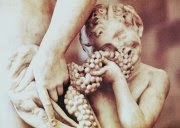
Friday, February 21, 2014

Parting with Ones Art

Anyone who knows me knows how I annoyed they should be of me because I just about hate anything that is done by my hand. We'll leave that up to those equally annoying people we call psychologists. But, there are exceptions. There is one, anyway. I did the drawing you will see below when I was in my late twenties and I remember it feeling right even at the time. At the risk of sounding too sulky and artistically sullen, this is quite the rarity for me. I'm a man who has put the boot through many a painting in my time and has torn to shred undeserving drawings at the drop of a sharpened piece of red chalk.
I do like this one. This might not be for reasons you and I agree with, however. I was happy to have captured that very elusive more than three quarter pose. This is a rather technical and, therefore, banal detail. 
I ought to like it for more than this but these are the rather banal things I see and, therefore, admire, or not. But, sometimes the mechanics of a drawing is what the creator of it becomes more bedazzled with than any of the more qualitative stuff. I found many artists, no matter how soulful, or how desiring of a narrative, often preoccupy themselves the many mechanical aspects of creation. May be this is why the artist might give up the rest (essence, feel, meaning, etc) to others.  The act of working on something that requires problem solving and a more logical part of the brain can often take precedence over anything like 'feeling.' True analysis is seemingly 'subcontracted' out. A work of art---ones own---is often a child one loved, and hated, and certainly laboured over for hopefuly all the right reasons but has now been given over to others and now it is they that will make the decisions as to what is right for her. I gave this one up in this way but I also literally gave it up as well.

I wouldn't even feign in any form or fashion to compare myself to Michelangelo but, it may be worth conveying a wonderful description of the great artists living conditions. It was described that he had a first floor stall for his horses and above that, on the second floor, he kept his own house. When some nephew or other made a visit to the notoriously cranky sculptor, he remarked (documented) that the famous artist lived a very sparse domesticated existence. This included the artwork on the walls. This nephew said that on entering the great artist's abode, he was struck that there was but one single drawing, a hanging Christ on the wall, hanging itself, by a single, unexceptional nail. Contrast this with the man who gave us the Sistine Ceiling.
Since then, and because of this, I've often ruminated on the thought that when I'm frail and bedridden, and unworthy of even an argument, they might find this drawing tacked to the wall. I don't ask for much. As mentioned, it's one of the few of mine I feigned to like. Anyway, that's impossible now as it's somewhere in Europe. It is the only one I liked. That's ok.  I'll draw another one.

Red chalk on Newsprint


Thursday, February 6, 2014

At the Met

What is at the bottom is a poem. What comes before it is a little insight in to how and why it came about.

A peak inside the untidy world of creation.


I recall---and so far have failed to forget as I tell it to you now---something I’d read about our favourite dipsomaniacal wordsmith, Charles Bukowski. When recollecting his early years as a young, penniless, peripatetic writer travelling the country during World War II, he often revisited in memory the sheer squalor of his lonely years moving from cheap hotel room to sordid boarding house to cheap hotel. He wrote of those travelling years walking on a knife’s edge that caused him to believe he would surely slip on that edge and impale himself through the heart. He more than once contemplated suicide.  
Never more was suicide at his elbow than when he found himself paperless.  Not money, of course, though that surely was a factor in being destitute.  No. His impoverishment was in the form of white paper needed to write. When out of sheets to place words is when he was most near despair. One night, with nary a piece to write on and just a nub of a pencil as his technological implement, he readied the noose. Before he could finalize the ‘easy cure,’ however, something seemingly insignificant stopped him in his tracks. He spied the margins of a newspaper. Blank white area, he realized!  He explained that what kept him alive on at least one occasion was the free, unmarked area of the margins of the newspaper where he could continue writing words. Like a man underwater finding an alcove with small pockets of air to breath, he found a way to go on  thanks to roughly a half inch margin of white area around somebody’s Gazette or other, to stain with a pencil marks. He would continue to create.
I cannot by any stretch match anything in my own life that might compare to the circumstantial despair that Bukowski lived through during those his lean years. However, in my own pathetic way, I can relate to the margins.
The germination of the poem below sprung from a visit to the Metropolitan Museum of Art in New York City one blistering summer afternoon. Though things in the poem are not conveyed as they happened exactly, (I naturally take some artistic license) there were enough fragments of experiences I believed could be shaped in to a poem.  This is not a poem so I shall try to be accurate whilst being slightly vague. The problem was that I hadn't the means to write the ideas down as they came and I was deathly afraid I would lose them. Who, after all, when one gets right down to it, even in the most intimate recesses of the mind, truly trusts their own recollective abilities when it comes to ideas not yet shared? Sure, we may believe we have been the eyewitness to something, or recall an argument we are sure went our way.  But to believe we can manufacture again that eureka moment is something we do not trust within ourselves. I am be being too objective here. May be I should say I cannot. On this particular day I was dictating words in the mind whilst at the same time feeling the excitement that possibly they were good ideas.  I know that even if I might have recalled them accurately the same excitement would be lost. If this were lost I would think the ideas were lacking.  If not a lack of true recollection at least a loss of spontaneity in the moment. A paradox of sorts to be sure.  
No matter what I recalled later they were in danger of losing the sheen. We know how this works. Like the initial images that present themselves with a quick flick of paint on a canvas, we are fixated and excited about our original and intuitive idea.  They come from the ether. There was nothing, now something. They seem the best and freshest early. However, when they are ideas for a written project, we become deathly afraid of losing them if they are not brought forth from the brain to something substantial like paper. They must be set down! This was my own squalor: Fear that imagination dried up beyond the first intuitive idea, if not grasped in time. My fear was that the excitement of primary imagination was only a mirage of ornateness that, if allowed to change with passing time, turned out to be nothing but a lumpy fold out bed, a Gideon’s bible in the drawer, and a neon sign shining a devious red through the curtains.
I walked out of the Met with a jumble of ideas and an unorganized collage of images. Worse than this, I was afraid of losing them. I walked the long path down 5th Avenue from the Museum at 80th to a friend’s place on 57th street. Walking south down 5th meant Central Park always at my right hand. I ignored it the whole way.  I was only thankful for the benches at every entrance. It was a blazing hot day and my brain melted seemingly taking my ideas with them in a kind of puddle of primordial soup. I tried desperately through the sweat to contain them. It felt as if the perspiration was from the exertion of holding on to them. I found myself sitting on every bench at every block to rest and collect my ideas. More to the point, I checked to see I still had them. It was at one of these rests, I realized I had white space around the margins of a few magazines I carried in plastic bag. I found a pen and feverishly wrote down these ideas at every sit-down at every block, filling in the white spaces on every page with ideas and lines. I walked and thought (and perspired) then stopped and thought then wrote. Soon enough as the blocks and hence, park benches added up and receded, I was able to piece together very loosely the poem below, haphazardly and cramped, in an array of untamed ink within the white margins of my magazines. It was hot as blazes. I was as soaked as white water rocks.
Anyway, none of this is quite parallel with the early, destitute life of Bukowski. I suppose, may be, I can say we both worked within the margins. We both might also agree it’s a cramped life. So is the Metropolitan Museum most days. The poem below is set there. The poem is simply about a little calm, real, unfabricated sophistication surrounded by a good deal of the opposite kind. Sometimes the surroundings are fabricated (like temples in a museum wing) and sometimes the inhabitants are unsophisticated (like tourists in that wing). The unforced and original sophistication can be in the form of a person. It may often be in the form of a child. It may often be in the form of a sophisticated child. It is rarely the artist. He is merely a detached watcher of things. When he is in his workshop he is clumsier. There is often no sophistication there. He often must stop at every block. He may often work in cramped places. He might often wipe copious amount of sweat from his brow. The poem:

At the Met

Roofed by Japanese temples and
Artificial light we stood. No rising

Sun from the east here. Rather from the east
wing. Our roof, as ornate as a geishas

Conversation is deceivingly simple,
Curled up at the four corners like a sultan's

Slippers towards a God though whose, I
Could not tell. I stood with a small worshipping

Mass whose saviour must be a giant eye
As the talisman's around their necks

Implied. Only I and my Buddha boy
Stood naked necked. His naked nape, bowed like

A lover's top lip and his shorn head, in
Danger of colliding with my hip, aimed

At our interest. A lady of the mass
With a voice like a bugled blare to send

The weary off to war, spoke. The small pool
Of water at the foot of the temple

We all penetrated with a glare (the
East know the importance of water, so

It's said). At the pools edge she read aloud
The sign: "Do not throw pennies as they might

Endanger the fish." What fish we all wondered?
Then: "Did I just see one scurry by?"

The question sent us all on a journey
And the ladies, camera eyes bouncing

Like bewildered demi-gods against
Ancient mountains, were off on the hunt.

"Do fish 'scurry'?"
"Is 'scurry' the word?"
"Who still says 'scurry'?"
"Well, what do fish do?"

The leaves of the Bodhi tree tickled the boy’s
Head, I could see. For silently, with fixed glare,

And all the aplomb of a cherry trees leaf
As it alights from its place, he whispered: "swim".

In an instant the light danced off the water
And rose and congealed a tight ball like a dying

Star. It ascended my face where the white
Heat thrust through my nostrils and the light

Flashed out my eyes. I staggered for a moment.
Blind and frightened, I leaned upon a pillar

And speculated: The superlative artist paints
Mount Fuji with a mere stroke of the wrist.

Saturday, February 1, 2014

Neanderthals in Heaven

Lady Neanderthal. My drawing. I was thinking how her work was never done.I was thinking this while mopping the floor this morning. I still think it's important to do things relatively laborious. It's fun to think of things to write while doing it as well... Lady neanderthal...

Last night I had a dream. I dreamt I died and went to heaven. I entered in to heaven and witnessed life in all its diversity enjoying eternity. Birds chirped, Pirates arghhed, and some suicide bomber enjoyed 72 virgins, sometimes two at a time, sometimes three. All this was done blissfully. I came across a neanderthal who grunted contentedly. Apparently God had forgotten to take away my annoying nature of questioning.
"Why don't you give this neanderthal a mind like mine," I inquired, "which would probably be more capable of really feeling and understanding bliss more deeply? He would grasp it more and his happiness would be heightened. Right?"

I smiled. God looked perturbed. 
He responded, "Why don't you mind your own business, you little creep. Who asked you? Besides, Einstein, you don’t have a “mind” anymore! How can you have a mind when you don’t have a brain? Huh? Didn’t you learn they were inextricably linked! Didn't you learn that down there? Hah! Answer that one!”
I asked, “You mean to say he doesn’t have a mind either?” 
I pointed to the Neanderthal as he masticated on a heavenly piece of mammoth meat.
I continued annoyingly, “If he doesn’t have a mind, how is he grunting? How does he know he’s enjoying it? In fact, why no brain but he gets a mouth and taste buds and..."
"He's fine!” God shouted annoyed. “Look! He's enjoying himself! That's the point! Doesn't it look like he’s enjoying himself? Doesn’t it appear so? That's the point! Eternal enjoyment! His own! Do you want to enjoy yourself, smartboy? Huh? Keep it up and you won’t! Keep it up and I'll punish you! Yeah! I'll punish you by giving you a mind like his! Would you like that? How would you like your eternal bliss to be steered with a brain like that?"
God caught himself. He looked embarrassed. He finished his thought in a mumble.
He whispered, "I mean a mind like that..."
 He trailed off. 
I frowned. Then, in a moment, I looked puzzled. So did God, for that matter, like a person who just uttered words while at the same time realizing the words were something even he couldn't decipher. I didn't want to cause more discomfort. But the stupid part of my brain could not stop.
I stuttered embarrassingly, "But...But...That would be...That proves me..."
I knew like a nerdy know-it-all I was turning the tension up. Why can't I just stop?
God cut me off. "Shut up! Just shut the hell up! Shut up!"

Moments passed. To break the tension I smiled a bit. I smiled and my voice took on a very playful tone. I said in a teasing manner, “God. Oh, God!. Are you just as confused as me? Hmmm?”
“Fuck you!” he shouted. But I spied him trying to hide a sly smile.
Even in my dreams I am an annoying little bastard. I must change.


Thursday, January 30, 2014

Wigged Ghosts

When tabled candle lights flicker like the
Misty moths that flit with and glass and dish
Fall to ground in a clarion crash, a
Cymbal-ic clash of echoic sound
Travailing thick night air, a ringing call as
A sign of no recourse but to blame for
It all the portly ghost of Benjamin
Franklin, is when one has no choice but to take
Another drink.

And the drink sits on the table, a wooded
Piece of scarred flesh as thick as centuries.
And the flickering light dances in and out
Of carved grooves in the wood, etched laments of
Lover’s compelled to scratch a pocket-knifed
Remark of the heart’s commitment for the
Alcoholic haze of ages. Among it all, the
Table, light, and the din of Franklin’s toppling
Of a dish the beer sits, black as nights, heady white,
In a summer sweated chill; in a puddle
Of his own piss.

And the lady wench, resigned, game, forced to
Dress in the times for a tip, tells you it’s
One of the General’s own concoctions.
News like this will force the mind to travail
Through time and steal away to another hour
And place; to a house upon a mount where, in
Some corner desk, the elixired recipe
Written in quilled ink the colour of the
Quaff sits among

The scribbled thoughts on men and freedom and
The occasional slave bill of sale; piled
Below sweetly aged, archaic, yellowed
Parchment, a recipe for beer. But the
Heat of the moment hazes the vision and
Causes the words to seep, to melt off the
Page in an infinite black river and meet
In the moment to what is the mouth of your
Specialty brew.

Outside, cobbled streets echo the footsteps
Of modern souls. A misty fog silently
Rises and congregates, as dense as
A swarm of lethargic angels, to envelop
An antiquated street lamp whose light shivers
With the power of electric currents keeping
The fog at bay. Above it all, tiny
Lights in the sky blindly blink on a
City of brothers; infinite mothers
Of kite and key.

Oh! George, might you laugh! Might you whistle through
Wood! Would you crease the corners of your mouth,
Slap a knickered knee and throw your head back
with a snort to know we tip the girl with
Pictures of you?

Wednesday, January 29, 2014

Self-Crowned King

I sat and shat and read my John Stuart 
Mill and read that he said that Monsieur 
Aurelius was a nice man in myriad ways 
Despite his attempt to keep Christians from 

Permeating his neighbourhoods. What may 
Seem now a crudeness was only a good man 
In the vital ways that transcend those 
Ethos usually ushered in by a new calendar. 

It makes sense to me while I sit and shit. 
Cold porcelain is never friendly to 
The back of warm thighs. But it may 
Aid in the ushering in of new thoughts. 

It has its utility in thoughts not to mention 
Those indispensable non-thoughts from the 
Other end. What is my utility now beyond 
The mere excretion which I only vaguely control? 

Would it be a mistake in category 
To say I have shit in my brains? The crudeness 
May be in the leaving it there. The usefulness 
Of it all may now be twofold; double 

Relief can work as one. I will lay the book at 
Bath's edge, thankful for it’s use, and proceed 
To relieve myself of wasteful thoughts. I will 
Be the throned philosopher-king as I sit and shit. 

Saturday, January 25, 2014

Ascend to Descend

Step each step, lightly on toes, lift yourself, my love.
If needs must, clip your wings within the narrow stairway.
Do not feign the winding flight but climb above
To meet me at the threshold with a kiss and say,

“I’ve come to your dream house, in from the uncalm,
To couch you again within a deep bosomed soul
Like some ghosts of old that wrap in ethereal arms."
Whisper this, come in, and I will do as I am told.

Wingless, it is easier to pass. Come through withal.
Let hands brush the dust on all my trinkets and pretty things,
Catch quick sight of oriental prints that cover the walls.
Let’s sit side by side and gaze and talk. Love clings,

For in your eyes I see you want to kiss again.
I can tell by the shine through the dusty glint,
We will do this and much more. This must be when
Each eyelid pulls passion down like a swimmer that sinks

And takes another with them. But, first!  Lift your view
One moment more. See the painted picture hanging there?
The one upon the wall suspended askew?
Catch it now. The lady descending a bamboo stair

As her lover stays, kimono robed, with a rose lapel.
Her geta slippers click with each sad step as she goes,
The man, holding back, knows these passions well,
As she ticks off time with each touch of her toes.

The rose with each petaled form will wither and die.
No mark will be left but the trace of a memory.
We then fight to trust through the eye of the mind
And are left to question if what we feel we see

Is felt. So a kiss, my love, once more. A stamp of
Remembrance before you descend. Go below
But, before you do, also leave a vestige of love.
Collect all the feathers of your wings as you go.

Friday, January 24, 2014

Wines and Whines

Here is my paradox: I get drunk often,
            And at times opportune, on the wine
 Of life.  Any and all finds my bloodstream soften
      And bulge at the banks: shadows that line

The window like puppetering silhouettes.
         Thoughts in the shower that shower me in
Thoughts that maybe, just maybe, I get
   Some jots of Spinoza.  And this is when I begin

 To give over to playful puzzle.  I want it prolonged. 
        Like unearthly sounds of sirens soft
 That subdue with inebriated song,
   I am lured by my thoughts aloft

Where they are as sensitively held
         Up like the wings of the flighted bird.
   And the very spirit of the mind alights and melts
        Into those things and thoughts that are observed.

I want it prolonged.  So enhancement takes
         The simple liquid form of
   The deepest darkest red, an ambrosial sate,
       A transfusional turn toward Bacchus’s blood,

  His for mine, so the sirens might sing on.
And shadowed shapes might shimmer anew.
      And the showered thoughts might fall upon
            A brain like a blade of grass with dew.

But beware. This need for dilation does not
        Make inspirative progress swell.
It can transform a man to a bloody sot
And serves to drown those original thoughts that welled

   With an all too natural flow,
     Then go to drought then seem as dead.   
          The alluring elixir in a slow
And poisonous meandering thread

 Drowns that natural high and more
    Than this, cause those thoughts to seep
Outside the realm of the original core
       And find them reach for forgetful sleep.

           So let those lofty thoughts both wax
     And wane in a natural swing and sway.
This is where the wine of life will not tax
        The need to force them, nor force them all away.